Revolutionizing Household Finance: A User-Centered Platform for Holistic Financial Management
A user-centered platform for holistic financial management and family collaboration.
This project addresses a major market problem: households juggle disconnected apps for budgeting, spending, forecasting, and account oversight. The platform integrates these functions into one cohesive system and adds predictive analytics and cooperative family governance tools to reduce cognitive load and improve long-term financial planning.
Full Abstract
The increasing complexity of household financial management has been exacerbated by the fragmented architecture of existing digital financial tools. Although discrete applications support budgeting, expenditure tracking, forecasting, and account oversight, a critical gap remains: the absence of a unified platform that facilitates integrated financial planning and collaborative familial governance. This study introduces a comprehensive digital solution aimed at remedying this deficiency through a consolidated user interface augmented by predictive analytics.
Consequently, this paper delineates and assesses a holistic platform that directly ameliorates the functional fragmentation. Empirical inquiries, encompassing quantitative (N = 342 survey) and qualitative (N = 35 interviews) methodologies, discerned salient disutility points, revealing significant cognitive burden and a low satisfaction (2.7/5) with extant applications. An iterative prototype developmental trajectory, progressing from low-fidelity schematics to a high-fidelity interactive simulacrum, was informed by key dissatisfactions identified in the initial user research and insights from iterative usability validation cycles. Subsequent comparative performance assessment corroborated the platform’s integrative schema, with a mean satisfaction of the proposed prototype of 84.2 out of 100 (SD = 7.9). Through synthesis of rigorous empirical methodologies with sophisticated algorithmic prognostications and resilient cooperative functionalities, this platform furnishes a pragmatic resolution, establishing a scalable archetypal framework for holistic, human-centered financial applications, augmenting the state of the art of financial management applications.
Key Features Highlighted from the FamilyPulse Case
- Unified dashboard that combines budgeting, transaction tracking, shared household goals, and account visibility in one view.
- Predictive financial insights to support upcoming expense planning and proactive risk detection.
- Collaborative household workflows (shared categories, role-aware access, and coordinated planning routines).
- Research-driven UX development from pain-point mapping to iterative low/high-fidelity prototypes and usability testing.
- Measured improvement in user outcomes, including stronger satisfaction and reduced management friction.
My Role
As first author and corresponding author, I led the full user-centered research-to-design pipeline across concept framing, empirical study design, evidence synthesis, experience architecture, and prototype iteration. I translated mixed-method findings into product requirements, defined the integrative interaction model, and shaped collaborative household governance and predictive planning workflows. I also served as the official presenter at the 27th International Conference on Human-Computer Interaction (HCII 2025), presenting the study and design outcomes. I led the user-centered research-to-design pipeline across concept framing, evidence synthesis, experience architecture, and prototype iteration. I translated mixed-method findings into product requirements, defined the integrative interaction model, and helped shape collaborative household governance features and predictive planning flows for a practical, scalable release direction.
Selected Visuals
Representative visuals sourced from the FamilyPulse case page.


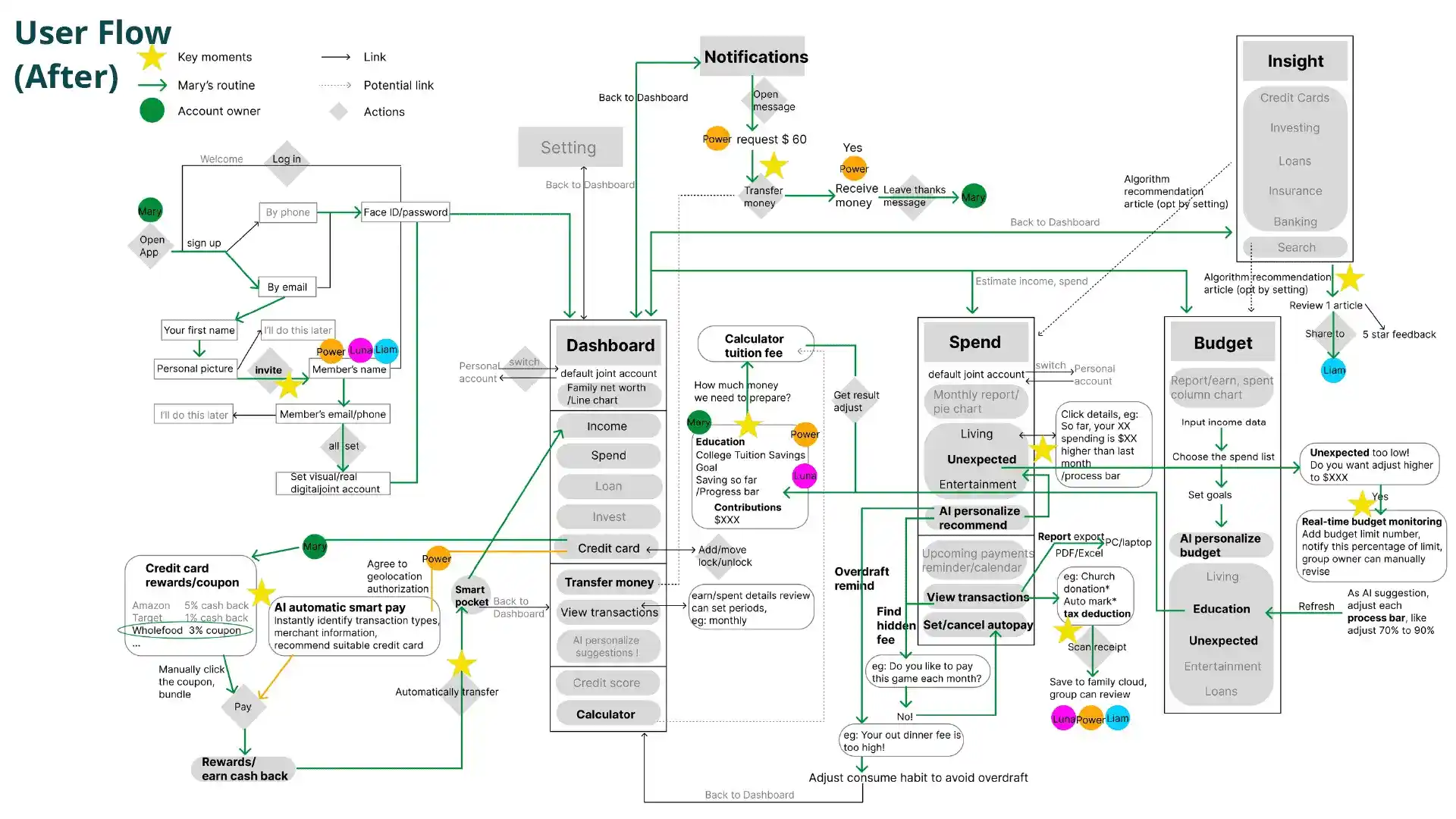

Additional information architecture reference: DFDraw Lab: FamilyPulse Case Study.
Full Citation
Dang, H., Ding, F. (2026). Revolutionizing Household Finance: A User-Centered Platform for Holistic Financial Management. In: Schrepp, M., Rauterberg, M. (eds) HCI International 2025 – Late Breaking Papers. HCII 2025. Lecture Notes in Computer Science, vol 16342. Springer, Cham. https://doi.org/10.1007/978-3-032-13164-5_2